
Franklin County Projected Versus Actual Release
A projected date is a calculation based on information in the correctional record at that time. IDOC calculates projected and mandatory dates for determinate sentences. Credits already applied can move the projection, and legally relevant lost time can affect the mandatory date. The actual release is a recorded custody event after staff finish the required checks.
A date can arrive without a community release. Another warrant, detainer, consecutive sentence, court change, or receiving agency may keep the person in custody. If Franklin County Jail sends someone to IDOC, the person has left county custody by transfer. The IDOC admission is not proof that the jail released that person into the community.
Pretrial detention works differently. A person awaiting a Franklin County case has no sentence-credit projection because no custodial sentence has yet been fixed. A detention or release order may authorize an exit, but the Sheriff still records when the person physically leaves and whether another hold intervened.
How to Find a Franklin County Projected Release Date
Start with the last verified custodian rather than guessing from the county of conviction. Franklin County can hold a local detainee, a person awaiting transfer, or a U.S. Marshals prisoner. Each status points to a different source.
- For an IDOC commitment, open the IDOC Individual in Custody Search and use the IDOC number when available.
- Compare the name, identifying data, sentencing county, and offense blocks before accepting a match.
- Read the full “Admission / Release / Discharge Info” area, including status, location, parole fields, and Projected Discharge Date.
- For a local sentence, obtain the mittimus or sentencing order from the Franklin County Circuit Clerk, then ask the Sheriff to confirm the local release record.
- On the expected day, check the current custodian again. Do not announce an exit from an older screenshot or an arithmetic estimate.
The IDOC tool may retain a record after institutional release, unlike a current county roster. It does not cover every short Franklin County jail booking. A person released locally without an IDOC commitment may have no state corrections record for that event.
Reading Franklin County IDOC Release Fields
IDOC labels answer different questions. “Parole Date” or “Last Paroled Date” can show the recorded move from an institution to parole or mandatory supervised release for that episode. “Status: PAROLE” with a parole district generally points to community supervision, not prison housing. “Projected Discharge Date” anticipates the end of the correctional or supervision obligation shown by IDOC and should not be treated as the prison gate date.
| Field | What it can establish |
|---|---|
| Admission Date | When the IDOC custody episode began. |
| Parole Date or Last Paroled Date | A recorded transition from institutional custody to supervision for that episode. |
| Projected Discharge Date | An expected end point for the IDOC obligation, subject to change. |
| Status and Location | Whether the record points to an institution, parole district, or another current state status. |
| Sentence Discharged?: YES/NO | Whether a particular sentence block is discharged, not necessarily whether all counts are complete. |
Read every sentence block. One count can say “YES” while another remains active. If the current location is an institution, one discharged count does not make the person released. If status says parole, describe institutional release with continuing supervision unless a final discharge source establishes more.
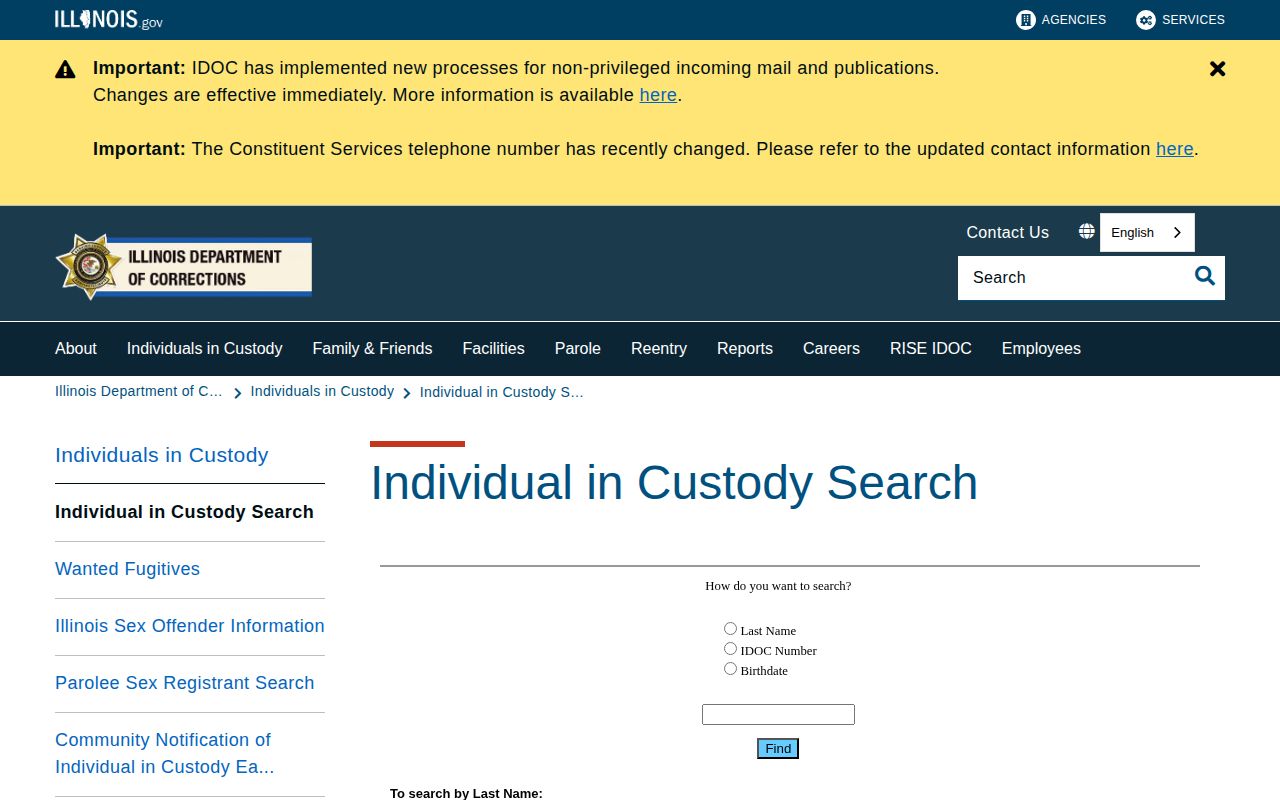
The official IDOC search screen shows why an identifier-based search is safer than selecting the first similar name. Visit the IDOC search source before using the available name or number fields.
Illinois Sentence Credit for Franklin County Releases
730 ILCS 5/3-6-3 controls Illinois sentence credit. Many determinate sentences use one day of statutory credit for each day served, often called day-for-day credit. That is not a universal rule. Offense-specific provisions can require service of 75, 85, or 100 percent, and the offense date, conviction, sentence date, and sentence structure all matter.
Illinois also authorizes eligible program, discretionary, and other credits, subject to exclusions and caps. Some later credit provisions preserve statutory minimums. A broad claim that everyone serves half, or that everyone serves 85 percent, is therefore wrong. The current statute and IDOC calculation must control.
Statutory sentence credit: credit authorized by law against an eligible sentence. Earned program credit: an eligible award recorded after qualifying activity. Mandatory supervised release: a supervision term that can follow institutional custody. Discharge: the end of the correctional obligation shown by the applicable record.
For a short county-jail sentence, use the court’s mittimus, credit for time already confined, and the law that applies to local custody. Copying an IDOC projection is improper unless IDOC actually holds the person. Bond and pretrial release are court-controlled exits, not good-time calculations.
How IDOC Recalculates a Franklin County Release Date
IDOC directives make the process more concrete. Directive 01.07.420 tells records staff to begin with the custody date, apply the sentence and applicable statutory credits, account for earlier time lost or awarded, and subtract a new earned-program-credit award to produce an adjusted projected date.
The award is entered in Offender 360, placed in the sentence worksheet or master record, and used to recalculate the projection. The individual is notified. IDOC also requires a two-person records review except when an urgent immediate-release calculation must be completed. These controls show that the field is a maintained agency calculation, not simple subtraction a reader can reliably perform from the sentence length.
Directive 01.07.400 separately addresses projected and mandatory release calculations for determinate sentences. A copied web date can become stale after records staff add credit, restore or revoke credit, correct jail time, or process a changed order.
What Changes a Franklin County Projected Release Date
The safest approach is to treat every projection as dated information. Several events can alter the calculation or prevent the expected community exit.
| Event | Possible effect | Best confirmation |
|---|---|---|
| Credit award, loss, or restoration | Moves the calculated projection under the governing rules. | IDOC record and sentence worksheet information. |
| Corrected jail credit or mittimus | Changes the custody starting point or sentence calculation. | Filed court order and corrections record. |
| Concurrent or consecutive clarification | Changes how multiple sentences combine. | Sentencing order and IDOC calculation. |
| New warrant or detainer | May block a community exit or cause a transfer. | Current custodian and destination field. |
| Absence or supervision violation | Can create lost time, revocation, or a new custody episode. | IDOC, PRB, and filed violation records. |
| Appellate or trial-court action | May amend, vacate, or correct the sentence. | Circuit Clerk or appellate court file. |
A PRB result also needs careful handling. A grant can require conditions, planning, and processing before physical release. A denial or deferral concerns that proceeding. Current determinate-sentence MSR does not always depend on the legacy discretionary hearing process, so check the sentence regime before treating an en banc date as the release date.
County Jail Release Dates Are Different
For a Franklin County Jail sentence, request the signed sentencing order and the Sheriff’s operational release record. The court document can show the term, jail credit, dismissal, probation, or other legal authority. The jail record can show when staff completed the exit and whether the destination was the community, IDOC, another county, USMS, or ICE.
The difference matters because the jail contracts to house U.S. Marshals prisoners and may house people for area counties. A person can leave the Benton jail for federal transport or another county without becoming free from custody. Ask the Sheriff to define any destination code rather than expanding it from memory.
No official Franklin County source reviewed publishes routine release-processing hours. Do not infer a release time from a court hearing or from when a name disappears online. The projected date is only a prompt to check the current record.
Confirm a Franklin County Release Event
On the expected date, check IDOC status for a state prisoner or call Franklin County Jail at 618-438-4841 for a local custody question. Illinois VINELink can report an event from a participating agency, but an alert may be delayed or may describe a transfer. The Franklin County VINELink check explains how to register and read the event language.
If the sources conflict, preserve the date each page was observed. Then ask the current custodian for the release reason, timestamp, and receiving agency. For an older event, use a focused FOIA request for the existing release record rather than asking the agency to calculate an answer.