
Franklin County VINELink Coverage
Illinois AVN through VINELink provides custody information from participating county correctional facilities and state corrections feeds. Coverage and event detail depend on the reporting agency. Confirm Franklin County in the live agency selector or result rather than assuming every local booking remains searchable. A result may show a reporting agency, an identifier, custody status, and an event. It is not a certified historical jail log.
County VINE information is relevant to a Franklin County Jail event. The IDOC feed becomes relevant after a state commitment. A transfer from the Benton jail to IDOC is not a community release, even though Franklin County custody ended. VINELink does not replace the BOP locator, ICE detainee locator, a federal docket, or a Sheriff FOIA request.
Search Franklin County VINELink
Identity must be matched before status is interpreted. Names can repeat, and one person can have several admissions or sentences. Use an offender ID, booking information, birth data, or agency detail when the interface offers it. Do not assume that the first same-name result concerns the Franklin County event at issue.
- Open the Illinois VINELink state page.
- Choose the people or offender search shown by the current interface.
- Enter the first and last name, then narrow with an ID or agency detail when offered.
- Compare every available identifier and reporting agency.
- Open only the record that matches the intended person and custody episode.
- Record the displayed status and event wording without changing “transfer” into “release.”
The broader Franklin County released-inmate search explains how to continue when VINELink returns no reliable match.
Franklin VINELink Release Fields
A current result can show the reporting agency and custody status. A released result may use released or out-of-custody wording and display an event date, but the exact labels vary. VINELink’s value is the agency-reported event. The Sheriff or IDOC remains the source for the release reason, timestamp, and destination.
| Displayed item | How to read it |
|---|---|
| Person name or identifier | Helps distinguish same-name records. |
| Reporting agency | Shows which custodian supplied the event. |
| Custody status | Reports the agency’s current status wording. |
| Event type | May identify release, transfer, or another change. |
| Event date | Dates the reported update, subject to agency timing. |
| Notification action | Shows whether registration is offered for that record. |
The official Illinois search interface is shown below. It documents the correct state service and should not expose a registrant’s private contact details.
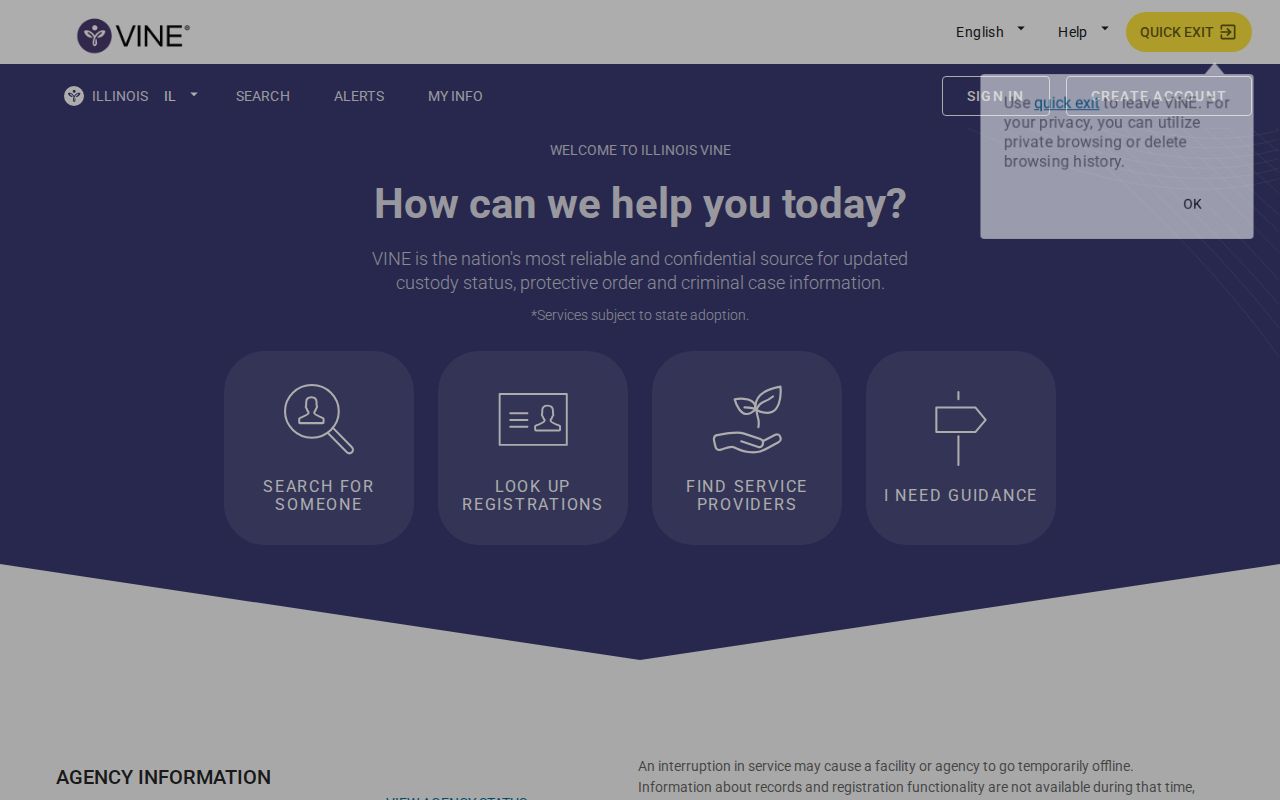
Recheck the live page because dynamic result wording and available actions can change.
Register Franklin Release Notifications
Registration begins from the correctly matched record. VINELink may offer telephone, text, email, or in-app delivery. Not every channel or event is offered for every record. Follow the choices displayed instead of assuming one uniform process.
- Select “Get Notified” or the current notification action.
- Choose an offered contact method and custody event.
- Enter the phone number or address in the secure interface.
- Complete the code and PIN steps shown. Telephone alerts may use a PIN to acknowledge calls.
- Accept the service terms and complete verification.
- Keep the registration confirmation private.
The modern account flow may send a six-character confirmation code by text or email and can offer a management PIN. Older phone instructions often stress an acknowledgment PIN. Never publish the phone number, email, code, or PIN. Viewing a person’s record by itself does not create an alert.
Confirm Franklin VINELink Alerts
After an alert, note the event, time received, reporting agency, and person identifier. Then call the Sheriff or consult IDOC to verify the actual release reason, timestamp, and destination. Alerts may be delayed, repeated, changed, or generated for transfers and returns. An unsuccessful notification call or canceled registration is not proof of custody status.
A BOP record may show “Released” and a date for a former federal prisoner, but federal supervised release or another custodian can remain. ICE uses its own locator. For a historical Franklin County jail event, request the Sheriff booking/release record. The service help line displayed by VINELink is 1-866-277-7477 and offers continuous multilingual operator help, but the custodian still controls the official event record.
Franklin VINELink Event Sequence
Read dates as a chain. Booking comes first. A court order can authorize release or transfer. The jail then records the physical change. VINELink reports the participating agency’s update. A later IDOC parole district, Franklin County probation record, or registry entry may describe a post-custody status.
When dates conflict, return to the custodian and the filed order. A VINE alert is useful corroboration, not a substitute for either source. A “not found” result also has limited meaning because coverage, spelling, identifiers, and historical display can vary.
Route Franklin VINELink Results
The reporting agency tells the reader where to verify next. For Franklin County Jail, call the Sheriff and request the booking/release record when the exact timestamp, reason, or destination matters. The local Sheriff page does not publish a 24-hour or 72-hour browser archive. A focused FOIA request can seek the existing release disposition and receiving-agency fields after a live display changes.
For IDOC, open the Individual in Custody Search and compare the IDOC number, status, location, admission, release, parole, and discharge fields. “Projected Discharge Date” is not necessarily the prison gate date. “Status: PAROLE” with a parole district points to release from institutional custody with supervision still in force. One sentence block marked discharged does not control other active counts.
For federal custody, use BOP only for a former or designated BOP prisoner. Franklin County Jail’s documented USMS contract role means a federal pretrial detainee may move between contract sites or court without entering BOP. Use the federal docket and USMS district in that situation. For a documented ICE transfer, use ICE’s separate locator and ERO route.
Manage Franklin Release Alerts
Keep registration details secure. A contact address, confirmation code, and PIN can control the notification. Do not place them in a screenshot, message, or public filing. When contact information changes, use the service’s management flow to update or replace the registration. A failed call attempt does not change the person’s custody status.
Choose only the events offered for the matched record. Phone, text, email, and app methods may differ by agency. The interface may ask for a verification code and management PIN, while telephone delivery may ask for a PIN to acknowledge the call. Follow the live prompts rather than an old set of steps.
After receiving notice, record what the service actually said. “Released,” “out of custody,” and “transferred” are not interchangeable. Ask the Sheriff or IDOC for the destination when safety, a court process, or reconnecting with the person depends on the answer. VINELink offers timely notice. The official record supplies the final detail.
Do not treat registration as a search archive. A notice documents what the service sent from a participating feed at a certain time. It may not explain a bond order, sentence credit, detainer, receiving agency, or later return to custody. Preserve the event wording and verify it through the correct office.
Read Franklin VINELink Status
Custody status is a snapshot. A person reported in Franklin County Jail is a local-custody inquiry. A person reported through IDOC belongs to the state system. If a record says released, look for the reporting agency and event date, then ask whether the event was a community release or transfer. Broad out-of-custody wording does not state where the person went.
Projected dates require separate care. IDOC’s live record can display a Parole Date or Last Paroled Date and a Projected Discharge Date. The parole field may document the move out of an institution for that sentence episode. The projected discharge field can concern the expected end of the correctional or supervision obligation. It should not be substituted for the physical release date.
Sentence-level fields can also differ. “Sentence Discharged?: YES” on one count does not prove the full record is closed. Read every count and the overall status. If the location still names an institution, do not call the person released because one sentence line ended. If the status is PAROLE, describe community supervision unless a final discharge source says otherwise.
For Franklin County probation, VINELink is not the sentencing record. Use the Circuit Clerk’s order and the county Probation Department. Probation is a court sentence supervised locally, while IDOC parole or mandatory supervised release follows state imprisonment. The county of conviction alone does not choose the state parole office, which depends on the assigned supervision region.
Public Record Search
Sponsored Results